Following Farmer’s thesis, a team of New Testament scholars has published two books on Luke and Mark respectively, in which they meticulously follow every verse and, based on the two-gospel theory, indicate per pericope how the lines run between the three evangelists. One can therefore follow Mark closely, for example, in his handling of the texts of Luke and Matthew. Often, the authors follow the attitude of the evangelist whom they follow, as it were, looking over his shoulder while writing, in the choices he makes, in the words, and in the ordering of the texts. At the beginning of that book, they provide a brief summary of the two-gospel hypothesis [1]. They present various types of evidence and distinguish five of them [2]:
1. Mark alternately agrees with the order of Mark and Luke. There are only a few cases where Mark is not in agreement with either.
2. Also within a specific pericope, Mark alternately agrees with Matthew or Luke in his choice of words.
3. Characteristic words and phrases of Matthew or Luke appear twice as often in pericopes where he follows Matthew, and when he follows Luke he has the same number of characteristic words for Luke. This is Zeller’s argument, who has made lists of those words [3]. If a word is not a characteristic Mark word and it appears in Mark in a text that he shares with Matthew and otherwise does not appear in Mark, then that is an indication that he adopted it because he has Matthew in mind, or he even has Matthew’s text before him. The same applies to Luke.
4. There is a network of words and phrases that are characteristic of Mark and that only appear in his Gospel and that network is a consistent whole both literary, historical and theological. It is called “The Marcan overlay” in this book.
5. In many pericopes, Matthew shows a well-structured argumentation based on the Jewish Bible, whereas the parallels in Mark are often fragmented and lack the carefully structured order found in the Matthew text [4]. This suggests that they are revisions of Matthew.
6. A significant amount of external evidence from the Church Fathers and later sources supports the conclusion that Mark made use of Matthew and Luke.
I wish to illustrate these types of evidence by following the authors further in their commentaries. Point 6, however valuable and important it may be, I will leave out of consideration here.
1. Alternate correspondence
Mark alternately corresponds to the order of Mark and Luke. There are only a few instances where Mark is inconsistent with neither.
In this regard, I make use of a table by Griesbach, the New Testament scholar who introduced the 2 Gospels hypothesis as early as the 18th century, which is therefore often named after him, the Griesbach hypothesis. He has proposed a table in which this is clearly visible [5]. The reader can verify this for himself. The reader may also be able to determine (although this is much easier in Greek and often Greek is even indispensable to see it) to what extent Mark has a preference for the words of the evangelist he is following at that moment.
| Matthew | Mark | Luke |
| 1,2 | – | |
| 3: 1-4: 22 | 1: 1-20 | |
| 1: 21 – 39 | 4: 31 – 44 | |
| – | (5: 1-11) | |
| 1: 40-3: 6 | 5: 12-6: 11 | |
| 12: 15,16 | 3: 7-12 | |
| (12: 17 – 21) | – | |
| 3: 13 – 19 | 6: 12 – 16 | |
| 12: 22,23 | 3: 22 – 30 | |
| (12: 33 – 37) | – | |
| (12: 38 – 45) | – | |
| 12: 46 – 50 | 3: 31-35 | |
| 13: 1-23 | 4: 1-20 | |
| 4: 21 – 25 | 8: 16 – 18 | |
| (13: 24 – 30) | 4: 26 – 29 | |
| 13: 31,32 | 4: 30 – 32 | |
| 13: 34,35 | 4: 33,34 | |
| – | (8: 19 – 21) | |
| 4: 35 – 41 | 8: 22 – 25 | |
| 5: 1-43 | 8: 26 – 56 | |
| 13: 53 – 58 | 6: 1-6 | |
| 6: 7-13 | 9: 1-6 | |
| 14: 1-2 | 6: 14 – 16 | 9: 7-9 |
| 14: 3-12 | 6: 17 – 29 | |
| 6: 30,31 | 9: 10 | |
| 14: 13 – 21 | 6: 32 – 44 | 9: 11 – 17 |
| 14: 22 – 16: 12 | 6: 45-8: 21 | |
| (18: 10 – 35) | – | |
| – | (9: 51 – 18: 14) | |
| 19: 1-12 | 10: 1-12 | |
| 19: 13 – 23: 1 | 10: 13 – 12: 38 | 18: 15 – 20: 45 |
| (23: 1-39) | – | |
| 12: 38 – 44 | 20: 45 – 21: 4 | |
| 24: 1-36 | 13: 1-32 | 21: 5ff |
| (24: 37 – 25: 46) | 13: 33 – 36 | |
| 26: 1-28: 8 | 14: 1-16: 8 | |
| 16: 9 | ||
| (28: 9-15) | – | |
| (28: 16 – 17) | – | |
| 16: 10 – 13 | 24: 10 – 35 | |
| 16: 14 | 24: 36 – 43 | |
| 28: 18 – 20 | 16: 15 – 18 | |
| 16: 19 | 24: 50,51 | |
| 16: 20 |
2. Alternate correspondence within a pericope
Also within a specific pericope, Mark alternately agrees with Matthew or Luke in his choice of words. Mark often uses compound sentences [6]. If Matthew has a certain word and Luke has a different word for the same phenomenon, Mark often uses both words, as if he wants to keep them both happy. His choice of words is more in line with the Gospel (Luke or Matthew) he is following at that moment.
An example follows below. What Mark has taken from Luke is indicated in bold, and what Mark has taken from Matthew is indicated in italics + bold. In the column for Matthew and Luke, respectively, their equivalent formulation is indicated only in italics.
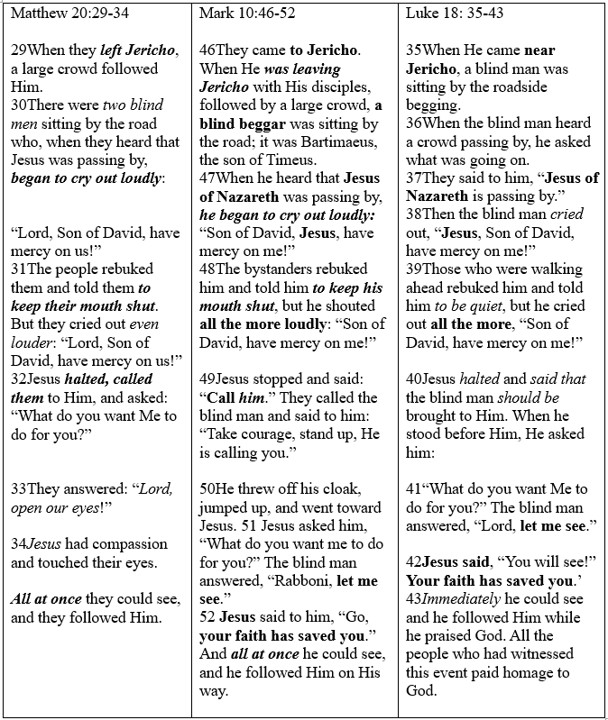
From a comparison of the texts above, it can be concluded that Mark often derives his choice of words alternately from the manner of expression of Luke and Matthew. He does this even in texts where he demonstrably follows one of the two in particular. Apparently, he consciously wants to do justice to both sources.
3. Characteristic words and phrases
Characteristic words and phrases of Matthew or Luke appear twice as often in pericopes where Mark follows Matthew, and when he follows Luke, he has the same number of characteristic words as Luke. This is, once again, Zeller’s argument, who has made overview lists of this phenomenon [7]. If a word is not a characteristic Mark word and it appears in Mark in a text that he shares with Matthew and not elsewhere in Mark, then that is an indication that he adopted it because he has Matthew in mind. The same applies to Luke.
There is a simple method to establish this empirically as well. As early as 1843, Zeller made lists of words and expressions that occur particularly frequently in each of the four evangelists. If a word appears frequently in one of the evangelists and another uses it hardly or not at all, and at the same time that word appears in a parallel text by that other evangelist, then this can be interpreted as an indication that the latter evangelist (who rarely or not at all uses the word but does use it in the context in which the other evangelist also uses it) has adopted it. It is therefore an indication of the order in which those texts were written, an indication of who is the source for whom. It is never more than an indication, but if the indications accumulate, indications can indeed become a frequently indicated fact.
4. A network of words and phrases
There is a network of words and phrases that are characteristic of Mark and that occur only in his Gospel, and that network is a consistent whole both literary, historical, and theological. It is called “The Marcan overlay” in this book [8].
The network of words that Mark uses serves his theological agenda. He does draw from Matthew and Luke, but he does so in a creative way in giving his story of Jesus’ life, mission, death, and resurrection, and he does so by weaving together material from the earlier Gospels. The entire book “One Gospel from Two” deals with such characteristics. An example is the word “palin” (“again/once again”). Mark uses that word fifteen times, and it gives structure to his Gospel because this word refers back to the earlier use of the word: each time that word is used, there is a new section. None of these times that Mark uses it is adopted (if this is the order between the Gospels), neither by Luke nor by Matthew, and that is remarkable [9]. Even more remarkable is that this entire network of characteristic word references does not occur in the other Gospels. What might that say about the order of the Gospels? A number of characteristic phenomena of this “overlay” [10]:
Jesus is portrayed as a teacher who brings a new teaching. From the beginning of the Gospel (Mark 1:1), it is clear that a significant part of this teaching consisted of the healing and curing work that Jesus performed. For Mark, Jesus’ announcement of the coming Kingdom is the Gospel, the Word of God that has saving power (Mark 1:14). All these words—teaching, Gospel, Word—appear independently, as if it is already clear what is meant by them. Jesus emphasizes, for example in the parable of the sower, the impact that the Word would have. The time of the Gospel has been fulfilled and revealed to the inner group of the disciples. The mystery of the Kingdom (Mark 4:12) consists in Jesus’ own life and destiny. This secret/mystery is accessible to everyone who can see and hear (Mark 4:24), but some cannot see it (interpretation of the parable of the sower). Fundamental to the gospel is the question of whether the disciples will see, hear, and understand, or perhaps also fall into the category of those who do not understand because their hearts are hardened (Mark 6:52 and following).
The road from Galilee to Jerusalem is Jesus’ self-revelation (Mark 8:27). While on the road, whether in a house or before a select group, but also in a more open environment, Jesus is engaged in his teaching, and that teaching concerns his suffering, death, burial, and resurrection. But the disciples consistently fail to understand (Mark 9:32, etc.).
In Jerusalem, Jesus literally fulfills what he has said. Peter has denied him three times before the rooster has crowed twice (Mark 14:30, 72). He is spat upon. The disciples flee when Jesus is arrested, but are called again to follow him on the road just as a formerly blind man did, Bar Timaeus (Mark 10:46-52). They must be baptized with his baptism and drink from his cup (see the Last Supper and Jesus’ suffering prayer in Gethsemane).
a. “The Gospel” and “the Word” as nouns
Mark speaks of “the Gospel” as a noun, which does not occur anywhere else in the other Gospels. It does occur in Paul. It is possible that Mark adopts this usage from Paul, for example from the Epistle to the Romans, as part of a compromise proposal: one does not have to choose between the Gospel of Matthew or that of Luke as the only true one. Each Gospel gives a specific version. And that is fine.
Mark does the same with “the Word.” This occurs, among other places, in the Parable of the Sower. In Mark 4:14, Mark changes Matthew’s expression “word of the kingdom” (Matthew 13:19) and Luke’s comparable expression “word of God” (Luke 8:11) simply into “the word”. In doing so, he also achieves a compromise between the word choices of Matthew and Luke. “The word” in Mark is equivalent to “the gospel” and refers to suffering, death, and resurrection [11].
b. “The mystery” as a noun
The third term specific to Mark, albeit appearing only once, is the term “mystery” (Mark 4:11, corresponding to Matthew 13:11 and Luke 8:1 “to know the mysteries”). Here there is also a link to the letters of Paul. Paul uses the word mystery in Ephesians 6:19 and 3:1-7.
c. Suffering, death, and resurrection as a motif in the stories
Mark speaks of the resurrection “after three days,” as Paul also does in 1 Corinthians 15:3-7, but differently from Matthew and Luke. They use the expression: “on the third day.” The motif of death and resurrection also appears repeatedly in the framing of some of the miracle stories. For example, the words “she was raised” are used (Mark 1:31). Mark does the same in the story of the healing of Peter’s mother-in-law (Mark 1:29-31). Regarding the boy who had an evil spirit, Mark also notes that the evil spirit seized him so much that he lay as if dead and that people said “he is dead” (Mark 9:26). Then Jesus raises him up and he rises.
d. Private instruction
Often in Mark, Jesus gives instruction to his disciples in a house. Where necessary, he adapts the text of Matthew for this purpose when it speaks of public teaching (Matthew 17:19 in Mark 9:27). In this way, a clearer distinction is made between an inner group that ought to understand and an outer group that cannot or will not arrive at understanding.
e. A liturgical motif
Mark’s counting of days and hours in the story of Jesus’ trial, crucifixion, and resurrection reveals a liturgical use of the Gospel. Because Mark’s Holy Week is one day longer than in the other Gospels, it runs from Palm Sunday to the resurrection. Mark achieves this result by taking two days for the entry into Jerusalem and the cleansing of the temple, which occur on the same day in the other Gospels. In the story of the crucifixion, Mark also keeps track of hours and times (Mark 15), and the concluding words of the apocalyptic discourse (Mark 13), which call for vigilance, also indicate a rhythm: “35Therefore be watchful, for you do not know when the master of the house is coming, in the evening, or at midnight, or at the first crowing of the rooster, or early in the morning. 36Let him not find you sleeping when he comes suddenly. 37What I say to you, I say to everyone: be watchful!” The liturgy of the meetings supports the practice of life. The members of the historical Christian faith community must constantly take up their cross to follow Jesus and lose their lives to the Gospel (Mark 8:35, 10:29, etc.), by being watchful for the sake of the fulfillment of God’s plan and proclaiming the Gospel to all nations.
f. Sacramental Motifs
When the sons of Zebedee ask Jesus to be allowed to rule in his kingdom on his left and right beside his throne, Jesus says: “You do not know what you are asking. Can you drink the cup that I must drink or undergo the baptism that I must undergo?” By emphasizing baptism and the cup in his answer, Mark reinforces the sacramental character of the suffering and death (Matthew 20:21-23/Mark 10:37-39, see also Luke 22:24-30 and Luke 12:50). Mark’s understanding of baptism as “dying and rising with Christ” is likewise in accordance with the Pauline tradition (Romans 6:4), as is his preference for the term “the Gospel.” Also in the version Mark gives of Matthew 16:9-12, in Mark 8:19-21 he supplements Matthew’s version by using more explicit Eucharistic language, borrowed from the stories of the feeding of the 5,000 and the 4,000 [12].
g. The blindness of the disciples
Mark repeatedly reinforces the depiction of the blindness and incomprehension of the disciples compared to Matthew and Luke. See Mark 6:52, Mark 3:17, similar additions to Mark 3:5 and Mark 8:14-21, especially 8:17.
h. The healing efficacy of Jesus
Mark prefers to use the title “didaskale” for Jesus, more so than Luke and Matthew. Mark thereby shows that he considers the teaching of Jesus no less important than Matthew and Luke, although he tells less about the content. When Jesus cast out an evil spirit, people say: “What is this, new teaching?”, see Mark 1:27; Luke 4:36. 6 [13]. In other words, what is taught is not wise words but a way of life. And that way of life involves bringing resurrection in the midst of the realm of death. Moreover, Mark tells every miracle story that both Matthew and Luke have. He only adds two of his own (Mark 7:32-37 and Mark 8:22-26).
i. Use of foreign language words
Mark often supplements the texts of Matthew and Luke with Aramaic-sounding words. Sometimes these sound like magic formulas, as in Mark 5:41 and 7:34, where he heals a blind man with the word “Ephphatha,” “be opened.” But Mark also provides the translation. In addition, he has a number of Latin loanwords.
5. Matthew disturbed
In many pericopes, Matthew shows a well-structured argumentation based on Scripture, whereas the parallels in Luke and Mark are often fragmented and lack the carefully structured order found in the Matthew text. This suggests that they are revisions of Matthew.
Matthew’s texts are often poetic, well-organized, with balanced repetitions [14]. Both Luke and Mark break the order of the texts. The question then is: is that indeed what is happening, or has Matthew in turn significantly improved Mark’s “messy” way of formulating things? Who has edited whom? When one looks at the examples, it is much easier to imagine that a certain order present in Matthew was discarded by Luke and Mark than the reverse [15]
6. External evidence
A considerable amount of external evidence from the Church Fathers and later sources supports the conclusion that Mark made use of Matthew and Luke.
“One gospel from two” provides a fairly extensive overview of the commentaries of the Church Fathers. Much can also be found on this in Farmer and others. Since I wish to stick to the text of the Gospels themselves here, I will not go into this, except with the remark that in the text-critical period the evidence of the Church Fathers was too quickly dismissed as biased. Naturally, one did not recognize one’s own often Protestant bias in doing so.
The origin and purpose of Mark
The text of Mark must be read against the background of his socio-historical world. We need both approaches: text and historical background. The authors of “One gospel from two” maintain that Mark was written in Rome, 10 or 20 years after the martyrdom of Peter and Paul [16]. The First Epistle of Clement shows that other persecutions occurred after the death of Peter and Paul in Rome during the persecutions of Nero. However, the fact that there are few literary sources makes it impossible to determine exactly what happened during this time.
The actors are Jesus, the disciples, and the political authorities. Faithfulness to the Gospel is central. Jesus is faithful to the Gospel, the political authorities stand at the other end of the spectrum, and the disciples stand in between. They waver between faith and unbelief. Therefore, from the very beginning, the trial is central, as Mark also makes clear with the arrest of John the Baptist in Mark 1:14. Despite the display of power by Jesus as the Son of God, the Kingdom lives a hidden life; it is misunderstood and treated shamefully by the authorities. The mystery of the Kingdom lies in the fact that there is a direct connection between the marginalized mission of Jesus and the rise of God’s new world, where the promise of Jesus’ life will ultimately become visible. And so it is for the Christian community for which Mark writes.
Moreover, the word of the Kingdom functions as a word entering from the outside into a church that is preoccupied with itself in its marginalization and with its internal struggle, with the danger of overlooking the truth about the workings of the government of God. The community leaders do not represent the ideal but show the actual lived answers to the crisis people are undergoing. This allows readers to identify with them and see the connection to their own life situation [17]. The disciples, too, are not up to the task and, for example, fail to cast out demons (Mark 6:7b-13). The request of James and John for a prominent position in the future kingdom shows the selfish ambition of the so-called leaders. The disciples are warned of the day when they too must pass the test of their devotion to the gospel. This also makes the strong focus on Peter’s failure understandable. “A Christian reader of old could not have a more vivid portrait drawn before their eyes of what is at stake to stand firm in the way of the kingdom” [18]. Jesus foretold that the disciples would become unfaithful and betray him. But he also promised that a life of discipleship would lead to reconciliation and victory. Because Mark selected certain words of Jesus to pass on and not others, the selection must have been determined by the intention of this evangelist. There are a number of changes that Mark made compared to Matthew and Luke, as discussed above, and these are significant.
Mark’s message is not, as with Matthew, the “Gospel of the Kingdom,” nor is it Luke’s announcement of the fulfillment of the prophets’ promises regarding the restoration of Israel. For Mark, the story of Jesus’ life shows how God’s saving power (Gospel) becomes manifest and makes a claim on the world. Mark’s Gentile-Christian readers are called to be faithful and to bring this Gospel to all creation. “This Gospel was first promised in Isaiah (Mark 1:1-2), came to light with Jesus’ preaching (Mark 1:14-15), and is accepted in following a certain way of life (Mark 8:35; 10:29)” [19]. Mark adopts the transmitted textual material of Peter and Paul, as also found in Luke and Acts, and makes this the framework of his story. Mark presents the core of Jesus’ mission in Galilee as a story of Jesus’ wisdom and power. The Christian-Jewish Matthew had followers primarily in Syria. Luke mainly in the churches of Paul in the diaspora. The tensions between the two were evident. This has been felt as a problem. Mark writes a gospel that reduces the differences. That is a primary goal. The second is to show that Jesus embodies the appearance of the Son of God whose service and power were contained in an enormous mystery, that of the crucifixion [20]. After the humiliation as the crucified Son of God, he was restored to honor. Mark’s goal was to remind believers that in their marginalization, they are following the path of Jesus.
This theological agenda also explains the many omissions of texts found in Matthew and Luke. His goal is to remind the doubting believers of his time that, in their marginalization, they must follow the way of Jesus.
[1] Peabody, B., et al. 2002. One Gospel from Two; Mark’s Use of Matthew and Luke, Trinity Press International, Harrisburg, London, New York.
[2] The English has two words here. It is not about a logical proof, but about indications that accumulate and together provide a picture.
[3] Included in the book starting on page 354.
[4] Goulder also often points this out in his book on Luke, but only in the way Luke deals with Matthew.
[5] Orchard, B., Longstaff, T. R.W., 1976. J.J. Griesbach: synoptic and text – critical studies 1776-1976, Cambridge University press, Cambridge, London, New York, Melbourne, p. 108 ff.
[6] Peabody 23.
[7] Zeller, E., 1843. Studien zur neutestamentlichen Theologie 4: Vergleichende Übersicht über den Wörtervorrath der neutestamentlichen Schriftsteller, in Theologische Jahrbücher 2, 443-5 143, see also Peabody 29.
[8] Peabody 35 ff.
[9] See Mark 2: 1,13; 3: 1.20; 4:1.5:21; 7:14.13; 8:1.13; 10:1,2, 10.32; 11: 27.
[10] Peabody 39.
[11] Peabody 41.
[12] Peabody 43.
[13] Peabody 44.
[14] Goulder also points this out in his book on Matthew. Matthew often uses formulations in threes, and has poetic and balanced repetitions. See Goulder, M., 1974. Midrash and Lection in Matthew, London, SPCK.
[15] See a number of examples on page 45, Peabody. The whole book is full of examples of this.
[16] Peabody 55: no motivation or reason is given.
[17] Peabody 58.
[18] Peabody 58.
[19] Peabody 61.
[20] Peabody 63.

