As early as 1951, Butler argued on the basis of accurate textual analysis that Matthew is the oldest Gospel and that Luke and Mark are based on this Gospel [1]. In doing so, Butler builds upon the work of Chapman, who also reached this conclusion in his book on the synoptic Gospels in the 1930s [2]. Both are of Catholic background, and this has certainly contributed to Protestant biblical scholars taking them less seriously than their research deserves. That was still the case back then. They were in suspicion of supporting the primacy of Peter and thus the Pope with their work.
It is a challenge in itself to follow this kind of textual analysis, whether by Butler or by others, because it is a complex puzzle. One also has to get used to this method of argumentation. This method of argumentation is complex because one must constantly consider and listen to a network of multiple texts. Even biblical scholars disagree on almost everything, and this disagreement is further compounded by the fact that people often do not take the time to listen patiently to the opponent’s arguments. They simply skim over the interpretations too quickly and consequently miss important details or misinterpret them. Butler has written only a thin book, but it contains an incredible amount if you read patiently. Here I provide a few examples of his textual analysis so that the reader can see how he proceeds and arrives at his conclusions.
The Sermon on the Mount and/or Sermon on the Plain
Butler follows the principle that one should not assume hypothetical sources unless it is truly necessary. His main question, therefore, is whether it is really necessary to assume a common third source for Matthew and Luke. If either of them could simply have used the other as a source and updated it for a new situation or a new audience, the assumption of a third original source is unnecessary. According to Butler, this indeed is the case. Luke is simply dependent on Matthew. According to him, Mark is also dependent on Matthew. However, he does assume that Luke, in turn, is dependent on Mark, alongside Matthew. So, the order is: Matthew, Mark, Luke. We will follow later with analyses showing that Mark comes after Luke and assess the evidential weight of this. The words “he does assume” are not entirely appropriate, for it is all about the evidence from the texts themselves. It concerns an empirical analysis, not a logical proof. It concerns an accumulation of indications.
First, we look at the relationship between Luke and Mark. Butler readily accepts that Luke comes after Mark, but there is reason to question that conviction, also here in the example Butler himself provides. He mentions the fact that Luke, who according to him follows Mark here, nevertheless reversed the order of events at the beginning of his sermon on the field.
In Mark, we read (Mark 3:7-19):
“7Jesus withdrew with his disciples to the lake, and a great multitude from Galilee followed him. Also from Judea 8 and Jerusalem, from Idumea and the region across the Jordan, and from the vicinity of Tyre and Sidon, many people came to him, because they had heard all that he was doing. 9He told his disciples to keep a boat ready for him, to prevent him from being trampled underfoot by the multitude. 10For all kinds of sick people pressed around to touch him, because he had already healed many people. 11Whenever the unclean spirits saw him, they fell down before him and cried out, ‘You are the Son of God!’ 12But he expressly forbade them to make known who he was.
13He went up on the mountain and called to Him all those whom He had chosen, and they came to Him. 14He appointed twelve of them as apostles; they were to accompany Him, and He wanted to send them out to proclaim the good news. 15They were also given the power to cast out demons. 16They were Simon, whom He gave the name Peter, 17James, the son of Zebedee, John, the brother of James (to these two He gave the name Boanerges, which means ‘sons of thunder’), 18Andrew, Philip, Bartholomew, Matthew, Thomas, James, the son of Alphaeus, Thaddeus, Simon the Canaanite 19and Judas Iscariot, who betrayed Him.”
Butler points out that Luke reverses the order between the two passages above [3]. Luke first tells of the appointment of the twelve apostles, then he tells of the boat that is needed. Then comes the Sermon on the Mount. In this way, Luke first creates an audience for his Sermon on the Mount: that is the inner circle of the disciples and then the people around them whom he also addresses later in Matthew in the Sermon on the Mount. Perhaps Luke also intends to correct Matthew with this, who only has the disciples appointed in chapter 10 and has already delivered the Sermon on the Mount long before that, in chapters 5-7. In that case, some disciples would have missed the Sermon on the Mount. That indeed does not seem entirely logical. Luke has already noted in the opening words of his Gospel that his predecessors did not always maintain the correct order. This could be an example.
Be that as it may, one might already wonder here how things stand between Mark and Luke. Butler assumes that Luke adapted Mark to his needs, but it could just as well be that Mark adapted Luke to his needs. This reversibility of arguments is a confusing element in the interpretations of New Testament scholars. Often, everyone relies too heavily on their own self-evident truths. Consequently, the proof of a hypothesis immediately becomes circular reasoning.
Mark has no Sermon on the Plain and neither a Sermon on the Mount. In Mark, Jesus is constantly doing something, and one action follows quickly after another. Within that framework, it is quite logical to first describe Jesus’ healing activity, and then to describe how Jesus appoints twelve disciples who are to do the same.
Matthew recounts how, even before the Sermon on the Mount, Jesus first selects only four disciples to travel with him through Galilee, visiting the synagogues. Then comes the Sermon on the Mount. In Matthew, Jesus only appoints the twelve disciples when he sends them out to go on a mission themselves, in Matthew 10. Yet, the Sermon on the Mount is intended for all his disciples. Perhaps Luke wants to emphasize this more emphatically, and maybe that is the reason he introduces the twelve disciples first and only then presents the Sermon on the Plain. Moreover, that Sermon on the Plain is no longer exclusively directed to the disciples of Jesus, but for everyone. It is a sermon in the open field and is not intended as a repetition of the legislation on Mount Sinai and the Old Testament, as Matthew portrays it. Luke wants all people to listen along. Surely the twelve disciples as well! Butler passes up this possibility of interpretation.
We read in Luke 6:12-19:
“12On one of those days Jesus went up on the mountain to pray to God, and He spent the whole night in prayer. 13 Early on the next day, He called His disciples to Him and chose twelve of them, whom He called apostles: 14Simon, to whom He gave the name Peter, his brother Andrew, James and John, Philip and Bartholomew, 15Matthew and Thomas, James, the son of Alphaeus, and Simon, called the Zealot, 16Judas, the son of James, and Judas Iscariot, who became a traitor.
17When He had come down the mountain with them, He stood at a place where it was level. There a large number of His disciples had gathered, as well as a multitude of people from all Judea and Jerusalem and from the coast region of Tyre and Sidon. 18They had come to listen to Him and to be healed of their diseases; also those who were afflicted by unclean spirits were healed. 19The whole crowd tried to touch Him because power went out from Him and He healed everyone.”
In Matthew, Jesus focuses primarily on his disciples and addresses them from the mountain. There is an association here with Moses and the giving of the law on Mount Sinai. In Luke’s Sermon on the Mount, this is also the case, but with many people around. On the mountain itself, he has already appointed his apostles, and now he comes down the mountain and, in the open field, accessible to everyone, proceeds to give his teaching. In this way, Luke tries not to tie what Jesus has to say so strongly to Mount Sinai, as Matthew’s Sermon on the Mount reminds us. This in itself points to a different communication strategy of Luke. In Luke, Jesus is always on the move, and this is also connected to the path through history that he opens for the Christian community. That Christian community, too, is a community that is constantly on the move.
That is possibly also the reason why Luke presents Matthew’s Sermon on the Mount scattered throughout his Gospel. He leaves almost nothing out—that is not the point—but everything is addressed in a different way and at a different place. Butler now demonstrates this in the text of Matthew’s Sermon on the Mount compared to Luke’s Sermon on the Plain.
While one can maintain that both sermons go back to one and the same original source, despite all the similarities, they are still very different. Luke’s Sermon on the Plain does not have that Palestinian-Jewish coloring that Matthew consistently has. Do they share a common source? Did Luke remove those Palestinian-Jewish characteristics, or did Matthew add them later? Butler lists a number of reasons indicating that Matthew is the source of Luke.
1. In Luke 6:23 we read: “23 Rejoice when that day comes and leap for joy, for your reward in heaven will be great. Remember that their ancestors treated the prophets in the same way.” There the word “reward” is used, “you will have a great reward in heaven”, Greek “misthos”. That is typically a word that occurs frequently in Matthew. Luke uses it only at one other location, and even then Matthew is the source, or at least, Matthew also has that word, so there is a certain probability that Luke borrows it from Matthew.
2. Verse 24: “24But woe to you who are rich, you have already received your portion.” The Greek word for “received” used here is again typically a Matthew word. Luke consistently uses a different word for receive. Could that Matthew word not still be echoing in Luke’s ears because he has Matthew with him?
3. Verse 27: “27To you who listen to Me I say: love your enemies, be good to those who hate you, 28bless those who curse you, pray for those who mistreat you.” Here Jesus is evidently no longer addressing merely his disciples. In the Matthew text that runs parallel to it (5: 43) we read “43You have heard that it was said: ‘You shall love your neighbor and hate your enemy’…” Luke abandons this reference to the Law of Moses, but it seems that he still has that “you have heard” ringing in his ears when he says “To you who listen to Me…”
4. Luke has added the words from verse 27 “…bless those who curse you, pray for those who mistreat you” to the text, at least in comparison with Matthew. This“bless those who curse you” could be a reference to Romans 12:14
“14Bless your persecutors; bless them, do not curse them” and the second “pray for those who mistreat you” Luke may have taken from Matthew 5:43 “43You have heard that it was said: ‘You shall love your neighbor and hate your enemy.’” (“mistreat” and “hate” in English are the same word “miseo” in Greek”). So you can actually still see the text of Matthew shimmering through the text of Luke.
5. In Luke 6:31 we read: “31Treat others as you want them to treat you.” The expression also appears this way in Matthew 7:12. That suggests direct adoption, even though it can be interpreted in two directions.
6. In Luke 6:35 and 36 we read: “35No, love your enemies, do good, and lend money to others without expecting anything in return; then you will be richly rewarded, and you will be children of the Most High, for He also is good to those who are ungrateful and ill-willed. 36Be merciful just as your Father is merciful.” The parallel in Matthew 5 is: “43You have heard that it was said: ‘You shall love your neighbor and hate your enemy.’ 44This is what I say about it: love your enemies and pray for those who persecute you; 45only then are you truly children of your Father in heaven. For He makes His sun rise on the good and the bad, and sends rain on the righteous and the unrighteous. 46Is it a merit if you love those who love you? Do not the tax collectors do the same? 47And if you treat only your brothers and sisters kindly, what extraordinary thing are you doing? Do not the Gentiles do the same? 48Be perfect, therefore, just as your heavenly Father is perfect.” When the word “father” first appears (Matthew 5:43), Luke replaces it with “Most High,” but in doing so, the reciprocity “children” – “father” that Matthew has is lost. Luke does not have the entire comparison with rain and sun regarding the evil and the good. He only has: “he is good to those who are ungrateful and malicious.” It seems as if he is summarizing Matthew and rendering it more concisely. In doing so, he also avoids the word “perfect” and replaces it with the word “merciful.” So not: you shall be perfect as the heavenly Father is perfect, but be merciful, as your Father is merciful. Luke should have either softened or explained that word “perfect,” according to Butler. In fact, Luke consistently avoids the word “perfect.” After all, the church is on its way and the goal has not yet been reached. For Matthew, it is different, for the goal, perfection (“telos”), has been reached with Christ. For him, it is necessary that the church stands where Christ stands. That fits with the persecutions following Stephen.
Butler provides further comparisons between texts from the Sermon on the Mount in the same vein. He concludes that it concerns the same sermon, but Luke made the sermon accessible to his target audience by minimizing the Jewish characteristics and by focusing on the relationship with neighbors/fellow human beings. One could also claim the opposite, Butler states [4], namely that Matthew made a supposed common source more Jewish, but that goes against the laws of “entropy”. In that case, an original source from which both Gospels spring would first have been characterized more by adaptation to Gentile Christians, and Matthew would have transformed that back into a virtually exclusively Jewish document. That is very unlikely, according to Butler.
How does Butler deal with Mark?
The question is whether Mark made a summary of Matthew or whether, conversely, Matthew integrated Mark into a larger story, according to Butler [5]. Mark is also dependent on Matthew, according to him. We take another example of a text as Butler treats it:
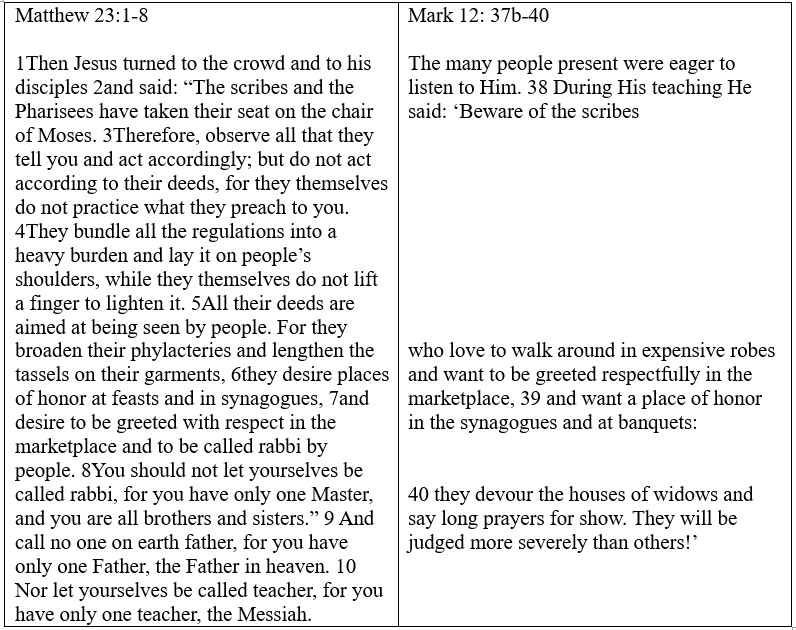
The passages above have so much in common that one must have copied them from the other. The question now is: who copied it from whom? Butler lists a number of considerations that indicate why Mark is secondary.
1. The passage is a whole in Matthew. The Pharisees do everything to make a good impression on the people.
2. In Matthew, verses 5b-10 form an inverted parallelism:
a: They show off with their phylacteries and tassels and clothes (5b).
b: They want the places of honor (6)
c: They want greetings in the streets and to be addressed as rabbi (7)
c: Do not let yourselves be called rabbi, for there is only one teacher and you are disciples (8)
b: Do not let yourselves be called father on earth, for there is a Father in heaven (9)
a: Do not let yourselves be called teacher, for only Christ is teacher (10).
In Mark, none of this is to be found. He turns Matthew into a single prosaic sentence. That must be secondary, according to Butler.
3. “Walking around in expensive robes” (Mark): apparently Mark has no desire to go into full detail about what tassels and phylacteries all signify. After all, he has an audience—as is evident from other texts by Mark—that knows little to nothing about the customs in Palestine. Moreover, that “walking around in expensive robes,” which Mark does have, is a somewhat bizarre sentence, as if it were a matter of childish vanity. You cannot possibly imagine, according to Butler, that conversely Matthew derived his entire poem from that peculiar little sentence of Mark.
4. The words of Mark stating “[want to be greeted]” are marked with square brackets because Matthew states: “They want to walk around in expensive robes and greetings in the synagogues and places of honor at meals.” That doesn’t flow well, whereas the same sentence works fine in Matthew. Is Mark messing up Matthew because he wants to keep the momentum going?
5. Mark himself has already stated that he is giving a summary, Mark 4:2 “During his teaching he said…”. Literally it reads “In his teaching he said…”. Mark repeats that statement again in verse 33: “33With such and other parables He proclaimed God’s message to them, as far as they could understand it”. In the parallel passage in Matthew, the teaching is indeed much more extensive, with many more words and parables. In other words, Mark himself indicates that he is omitting something [6].
Butler further points out that another exegete, Rawlingson, a supporter of the two-source theory, tries to salvage the matter by stating that Mark is probably quoting an older Roman version of the Q source here and is doing so from memory, while Luke and Matthew quote that source more extensively. Butler subtly mocks this: “Is it necessary to point out that the refusal to admit Mark’s direct dependence apparently drives someone to defend the position that (a) Mark used a document that we cannot distinguish from Matthew, and that at the same time (b) Matthew realized that Mark was giving a summary, and that he was in the fortunate possession of a copy of the document that Mark used (or a document that cannot be distinguished from it), and that he subsequently substituted that source entirely for Mark’s summary?” [7].
Butler gives many such examples. We will bring up one more here, the conclusion of the so-called eschatological discourse in Mark 13. Here, too, the question is whether Mark did not simply have Matthew before him when writing his gospel?
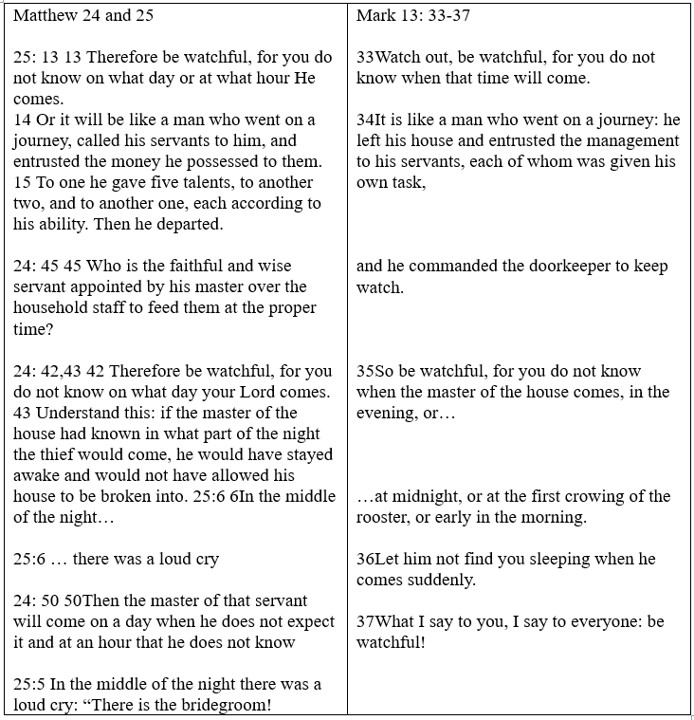
Mark concludes his apocalyptic discourse with Mark 13:33-37. Matthew’s apocalyptic discourse continues for quite some time and includes a number of parables that Mark omits. Omits? Or does he mention them briefly in passing? Verse 34 of Mark contains a reference to the parable of the talents in Matthew: a man goes on a journey and gives his staff a sum of money to use and make a profit. The second half of verse 34 is a reference to the servant appointed over the household staff in Matthew 24:45. That is Mark’s doorkeeper (is that perhaps also a reference to Peter?), the trustworthy servant in Matthew. However, in Mark, this doorkeeper (who in Matthew is tasked with distributing duties) is ordered to be watchful, which is in turn a reference to Matthew 24:42-43 concerning the master of the house who would certainly have kept watch if he had known when the thief was coming. The continuation of Mark, verse 35, refers back to Matthew 25:6 to the parable of the ten virgins, some of whom were watchful and others not, at the moment the bridegroom comes in the middle of the night and when it is suddenly called out that he is approaching. Verse 36 refers again to the servant in Matthew, this time the unworthy and wicked servant who beats his servants and is drunk. The point Butler makes in all of this is that one cannot imagine that Matthew devised this fabric of parables on the basis of Mark’s brief remarks. On the contrary, Mark probably felt that his speech was trying to hold the audience’s attention for too long anyway, and then cursorily took the remaining parables Matthew had left and quickly used what he could use to make his point, namely the need to be vigilant [8].
Mark insists on this vigilance: it is necessary to be vigilant because you do not know when the master of the house will return, in the evening or deep in the night, and you do not want him to come and find you sleeping. There is something strange about this summary. A man who goes on a journey and gives instructions for the daily work and the supervision thereof (Mark 13:34) does not expect you to be awake all night because he could return at any moment (Mark 13:35). Rather, he will ensure that he returns during the day and announces his arrival. In other words, Mark has mixed the parable of the talents and the parable of the thief who breaks in unexpectedly at night. At the end of his book—after having compared various passages throughout Mark/Matthew—Butler concludes, by now not entirely unexpectedly, that Matthew himself was the source for Mark. If, he states, we do not defend a preconceived theory but examine the texts themselves for connections, incoherences, and rearrangements, then no other solution is really possible [9]. It is quite possible that Matthew was indeed written in Hebrew, or perhaps in Aramaic, as tradition says. Many texts reflect the conditions of the time before 70 and after the persecutions that began following the death of Stephen. What is very striking in Matthew is that although the message of the gospel must be brought to all nations, the specific problems of the mission to the nations, as undertaken by Paul and Barnabas, are nowhere reflected in Matthew. It seems that the controversy between the Christians from among the Gentiles and the Christians from among the Jews was not yet a current issue at all. Conversely, therefore, according to Butler, Matthew was a source for both Mark and Luke, for whom these problems were indeed relevant. In a footnote on a book by Kilpatrick, Butler addresses Kilpatrick’s thesis that the Gospel originated after 70 in Phoenicia in a Christian community in opposition to Orthodox Judaism. According to Butler, this leads to a paradox given the historical development [10], and he can only imagine that Kilpatrick arrives at this conclusion because he dogmatically takes his starting point from the two-source theory. If that is the case, Matthew must be even later. He ends his book with the sentence: “As far as I am concerned, I suspect, and that is more than a suspicion, that in Mark we have Peter’s counter-signature against his fellow apostle Matthew” [11].
[1] Butler, B.C., 1951., The Originality of St. Matthew; a critique of the two-document hypothesis, Cambridge University Press.
[2] Chapman, J. 1937., Matthew, Mark and Luke; a Study in the Order and Interrelation of the Synoptic Gospels, Longmans, Green and Co. Rosenstock-Huessy also mentions this study by Chapman in The Fruit of our Lips.
[3] Butler 37.
[4] Butler 47.
[5] Butler 72-74.
[6] So also Chapman on the same passage, Chapman 5.
[7] Butler 76.
[8] Butler 83.84.
[9] Butler 163.
[10] Butler 166.
[11] Butler169.

