Otto Kroesen

The Four Gospels, at the crossroads of Four Realities – Otto Kroesen

Introduction

How should one read the Gospels if one shares Rosenstock-Huessy’s conviction that they knew one another and respond to one another? This question occupies me as not only a very fascinating but also a very important question. This contribution goes into it. The Gospels, so Rosenstock-Huessy establishes, are the first writings in antiquity to be in dialogue with one another, in a respectful conversation with one another. They do not wish to replace one another – that was the usual state of affairs in antiquity. Every philosophical school taught only its own truth. Every religious cult likewise. The Gospels, on the other hand, do not reject one another. They do not say to each other “no, because,” but instead “yes, but.” Admittedly, like any true dialogue, this yields abrasive truths. But precisely in this they complement one another and – that is Rosenstock-Huessy’s specific insight: in this way they bring the cross of reality to fulfillment. After all, the cross of reality means that truths that do not simply fit together still find alignment, albeit at the price of self-denial. The truths that do not fit together must make room for their opposite voice timely, because otherwise they cling to their own rightness for too long. Timing is everything. Timing is alignment, knowing when to stop. This only succeeds if you are called to order by a higher truth. That is the truth of the cross: you make the Righteous One a victim if you cling to your rightness for too long.

The four Gospels each focus on one of the four cultural currents in antiquity, but those four cultural currents also each represent one of the four poles of the cross of reality that is known and familiar to those acquainted with Rosenstock-Huessy as: legacy of the past, mandate of the future, dialogue within, effective action outside. That is always an uncomfortable tension. Those four poles of reality rub against each other and yet must find a certain alignment. They must be lifted from their joints to make room for the other poles. That is only possible if they overcome themselves and manage to stop, lifted from their own specific foundations by the Spirit of Christ. Thus, if the Gospels consistently focus on one of the four poles of the cross of reality, it is simultaneously their intention to translate that one pole upon which they focus into one or more of the other poles, and thus lead it back to the center of the cross of reality, from which they all spring.

Why the order is so important

Whoever wishes to understand this mutual dialogue that the Gospels represent, and allow it to sink in, cannot escape the question of the order of the Gospels’ origins, for you want to know who is responding to whom? Who looked over whose shoulder? Who felt compelled to say something that had already been said in a different way? You also want to know: why did this evangelist feel compelled to do so? Why did he need it, for his situation, target audience, or historical context, to say and formulate what was said yet in a different way? Where can one notice that modulation is taking place, so that what was said earlier sounds in a slightly different key?

It seems like nitpicking to ask such questions. That is why I would like to clarify this by using an example. For this, we will take Mark, because with Mark we immediately get to the important question of whether he is the first of the three synoptic Gospels or the last. Mark has no birth narratives and no resurrection narratives either. Is he familiar with them and did he omit them nonetheless? Or is his Gospel merely a first attempt, and did Matthew and Luke improve upon it? Let’s take a look.

Beginning and ending of Marcus

Mark immediately begins with the sentence “This is the beginning (or reign, arché in Greek) of the gospel of Jesus Christ, Son of God.” He also goes directly to John the Baptist and to the words “You are my beloved Son, in you I am well pleased,” at the baptism of Jesus (Mark 1: 10). He ends his Gospel with the women fleeing from the empty tomb “seized by fear and terror.” They were so frightened that they said nothing to anyone (Mark 16:8). This is followed by an account of the appearances of Jesus, but that is a short summary, perhaps by Mark himself, of what can be read in Matthew and Luke. Half of the surviving manuscripts end with the women running away in fear and fright.

So the beginning of Mark emphasizes the Sonship of Christ. There is no teaching of Christ, except the call for the disciples to imitate him. Throughout Mark, the disciples do not understand what Jesus means, and this is actually because they are not yet ready to follow him. The women at the empty grave also do not actually realize what is going on. Or better yet, they realize it, they understand that they now also have to follow Jesus and put aside the fear of death and persecution, but they flee from it.

The beginning and end of the gospel and also the entire intermediate gospel can only be properly understood from the point of view of the persecuted church in Rome. Then all the pieces of the puzzle fall into place. Nowhere more than in Rome is it questionable whether the emperor is really in charge or not. In Rome it is a revolutionary act to state right at the beginning of your writing that Jesus Christ is the Son of God – and therefore not the emperor, who, after all, demands himself to be called the Son of God by everyone. It has often been neglected that the imperial cult in the Roman Empire began immediately from the moment Octavian took power after the assassination of Caesar in 44 BC. It also became increasingly common in the empire to put an adoptive son on the throne. When Mark writes in Rome during the persecutions under Nero, the omission of the birth stories becomes understandable. Adoption comes before birth. Moreover, the adoption of a successor as a son takes place exactly in the formula with which Jesus is addressed when he comes up from the water of baptism. The heavens then tear open (!) and the Spirit descends on him in the form of a dove and the words sound: “You are my beloved Son, in you I am well pleased.” In Luke and Mark, Jesus is addressed directly in the second person – as did the Roman emperors with their adoptive sons. For comparison: Matthew tells the event in the third person: “This is my beloved Son, in whom I am well pleased,” Matthew 3: 17.

Then Marks ending: it is a remarkable ending and perhaps he thinks so himself too. Perhaps that is the reason that there is also a second ending, but he still wants to leave these words hanging for a while: “They went out and fled from the tomb, for they were terrified and shaken, and they were so frightened that they said nothing to anyone” (Mark 16:8). Thus the gospel ends with a cliffhanger. Hereby the question is posed to the reader: and now you! That question was certainly on the agenda in Rome during the persecutions under Nero: do you dare to speak out for the truth and stand for the Christian faith or do you say “I run away from it?”

There is more that points in this direction. I will mention one more thing: only Mark has the parable of the seed growing up to the harvest: “26And He said, ‘The kingdom of God is like a man who sows seed on the soil: 27he sleeps and rises day by day, while the seed sprouts and grows, although he does not know how. 28The soil of itself brings forth fruit, first the blade, then the ear, and then the ripe grain in the ear 29But as soon as the grain permits, he thrusts in the sickle, because it is time for the harvest’” (Mark 4: 26 – 29). This also ties in with the experiences in Rome. Discipleship means imitation and that means persecution. Even the teaching of Jesus only includes this one fact of the imitation and the exposure to persecution that is about to come, as in this parable.

There is constant fear and misunderstanding among the disciples of what is at stake. They still do not understand the secret of the Messiahship of Jesus nor of their own discipleship. Peter in particular is always wrong. One reason some give is that Peter instructed Mark to write it down this way, especially regarding his own failure. But Mark may also have had another consideration: in this way, the followers of Jesus can recognize themselves in the disciples/apostles. They face the same dilemma. They must pass the same test. It hasn’t been easy for anyone. That’s encouraging.

These findings fit well with Rosenstock-Huessy’s view of Mark. He also believes that Mark was the secretary of Peter and wrote his version of the Gospel in Rome. The Gospel of Mark is about overcoming the imperial cultures, where the stars are in power and the emperor is the executor of these divine powers. That is the worldview of Egypt that was adopted by the Roman Empire after the Senate was put aside.

Even if it is agreed that Mark was written in Rome and tailored to the Roman situation, there remains another debate among biblical scholars about whether Matthew and Luke were written after 70 or before 70, after Mark or before Mark. The year 70, with the destruction of the temple, plays an important role in this. According to many, Mark was also written shortly after the destruction of the temple in the year 70. In the Gospels, Jesus announces that destruction, and, so the reasoning goes, this could only have been thought of in retrospect. But there are also other arguments. Those who regard Mark as a first attempt, rather imperfectly and sloppily written, and who have a greater appreciation for the poetic parallelisms of Matthew and the beautiful Greek sentences of Luke and therefore believe that Mark needs improvement, also have reasons to place the work of Matthew and Luke after Mark.

There were also important crises before the year 70

I personally see two important arguments, in addition to a large number of less important ones, for not sharing this view that Mark is a first attempt. After all, the Gospels are not an office activity but arose from crises. The Gospels provide an answer to a crisis situation. They provide orientation. After all, the cross and resurrection of Christ are themselves the answer to a crisis. The new Christian faith is often implicitly attributed to the intellect, as if it were an invention of the mind. Or it is attributed to a revelation falling from the sky, which is equally beyond the sense of crisis. In both cases a new belief enters the scene and it still has to crystallize somewhat, just as thoughts crystallize. According to many, Mark was written like this because the first generation of Christians was dying out. Matthew would then have been written later, around the year 80, and would be the product of a Jewish-Christian rabbi who gave a more Jewish interpretation and addition to the Gospel of Mark. And finally, Luke would have written his version after Matthew in order to provide the Pauline churches, which were now in the majority, with a suitable version of the gospel. That is not adequate to the real events and not adequate to the experiential dimension of the revelation of Christ. Revelation always takes place in crises. A way must be opened where there is no way. A door opens. Something happens and only then do we think. That’s what happens.

What’s going on? It is true that the law of Moses was intended to bring justice, but in the hands of Pharisees and scribes the law has become rigid and has lost all inspiration. With Christ an impossible road is paved, namely to realize justice and goodness at the expense of and with the sacrifice of one’s own life and property. Anyone who accepts death as the outcome of his commitment to justice is free. That freedom is the resurrection. Christ has gone that road, the truth and the life, so in John. In John, especially and most importantly, the cross is also the resurrection itself. Jesus Christ and the martyrs who followed him recreated the world. That is not an intellectual pursuit. It is exposure to a death that is at the same time surrender to a supratemporal life. Eternal life (aionios, according to John) can best be translated as “surpassing life”. One surpasses one’s own life-time and exceeds one’s own life-time by living for a time beyond one’s own life-time. That is the true life and the true way forward. To write something down about it that can then be studied is even suspect. Because look how the Bible scholars and scribes of our days once again turn this into an intellectual object of study behind their desk and their laptop. From that position they also reconstruct the work of the Gospel writers, who are expected to be just like themselves. They put texts together.

The second important reason why Matthew and Luke should not be placed after Mark lies in the fact that even before the year 70 crisis and persecution were already part of the reality of the believers. Why would there only be a need to write something down when the first generation of Christian believers is dying out? After the murder of Stephen, Matthew and the other apostles were confronted with the fact that the small Christian community was persecuted, murdered and dispersed. Wouldn’t they need the written word, which gives them a backbone? After all, until then, a new experience had crystallized into language in Jerusalem for about ten years. Now only the apostles were left in Jerusalem. Isn’t there a need at that moment for a concise collection of sermons and teachings? The persecuted believers themselves need this to keep their motivation alive in a dire situation, and they also need to give an account of the new way and the new truth and the new life to suspicious outsiders. Matthew originated from that necessity and crisis. In other words, because Rosenstock-Huessy himself always sees historical crises as the birthplace of a new inspiration and a new way out, he also looks at the birth hour of the Gospels in this way. And anyone who looks this way cannot avoid noticing that Matthew is inexorably the first.

Matthew fulfills the first task that followers of Christ are confronted with: to give account to rigid Jewish legalism and to take a position against it. Against rigid legalism, Matthew contrasts the Torah with the Sermon on the Mount and the path of the Son of David to the cross, where he emerges as the Son of God. For Matthew this has nothing to do with a two-nature doctrine, but with authority and status: Christ reigns over the nations sitting at the right hand of the Father. Not only for John, but also for Matthew, “the Lord” and the Father are one.

Luke’s gospel was also necessary long before the year 90, the year many believe that Luke should have been written around that time. Here too, it is about more than an intellectual development. What is the situation? Paul found wide access among the Greek-speaking proselytes, the fellow Jews, people who were attracted to the faith of Israel’s prophets because they offered a moral alternative to the immoral swamp of the Roman Empire with its violent cynicism. The Greek cities were deprived of their political autonomy. The best people who could have made a difference through moral responsibility were therefore sidelined. However, they were also sidelined within the Jewish synagogue. Due to the dietary laws and circumcision they remained outsiders. The Greek word ecclesia, popular assembly, is not by accident the word that was also used for the “parliaments” of the Greek cities. By following Jewish inspiration, as it took shape in the way of Christ, those of the leading class who meant well could take their social responsibility. They took the many poor into their homes and provided them with meals as members of the house churches founded by Paul and his associates. Thus they formed an alternative political body within the Roman Empire. They did not need to be liberated from Jewish legalism like the churches in Palestine, because they had never participated in it. They were won over by the Jewish inspiration in the Jewish-Christian communities, which gave shape to this through practical social work. But Jewish legalism was also a persistent problem that continued to haunt them, just as it haunted Paul. Actually, they were not really Jews, even though they mirrored the life of the synagogue. Are they participating just for bacon and beans as an alternative half-Jewish movement, or do they represent a serious alternative? Paul, especially in the letter to the Galatians (Galatians 2:11-14), opposes legalistic Judaism, even if Peter and others still compromise with it, and he stands up for a new community as the way of Christ under the guidance of the Holy Spirit, as the body of Christ. It is important that they overcome their second-class status. That is the challenge Luke faces. In the Gospel of Luke and in the Acts of the Apostles he shows the formation of the many Christian communities from the people as a logical and self-evident path. Long before the year 70, these Christian communities, with many Jewish participants, were by far the majority over the specifically Jewish-Christian communities. But if these Christian communities want to be able to maintain themselves, even under the pressure and under the coming oppression of Rome – Paul sees this coming early on – they must find recognition.

Counterbalance to Jewish legalism

Just as Paul strongly and uncompromisingly opposes even Peter and Barnabas when they give in to the legalistic Judaism of the many Pharisees and the priests who have become members of the Christian congregations in Palestine, he undoubtedly also stimulated Luke to write an adaptation of Matthew. Tensions in the young church between the Pauline course and the course of “conservative” Jerusalem have risen high. Luke and Paul wanted the Christians from the nations to participate fully. After the murder of James, one of the sons of Zebedee, by Herod (Acts 12:2), and after the departure of Peter from Jerusalem, James, the brother of Jesus, took over the leadership of the church in Jerusalem. In the debate that follows, he plays a decisive role and says, according to Acts 15: 23: “For in almost every city the law of Moses has been proclaimed from time immemorial and read in the synagogues on every Sabbath.” Although he uses that insight to persuade the church in Jerusalem to approve the course of Paul and Barnabas, and not to ask for circumcision from the nations and to maintain the dietary laws, he is actually also saying: it will never become mainstream anyway! So let it go. Paul and Luke must therefore seek opposition with the Gospel of Luke and with Acts precisely in order to break open such a narrow insight. Luke traveled to Rome with Paul and undoubtedly he would have brought his version of the Gospel and the Acts of the Apostles with him.

Here is the existential need from which the Gospel of Luke and the Acts emerged. They thus complete the next task that the young Christian congregations face, namely to translate the inspiration of Israel to the situation and problems of the wealthy leaders of the new Christian congregations. For them, the Christian way has become attractive as an alternative ecclesia in the midst of the moral degradation of the Roman Empire. It makes it possible to work on change without turning to rebellion.

The Gospels evoke each other

In Rome, during the few years that Paul was able to walk freely there and that Peter joined him or was perhaps already there, Mark wrote a gospel that accomplishes three things at the same time:

1. In his gospel he bridges the contradictions between Luke and Matthew. In doing so he makes Luke and Matthew not mutually exclusive gospels, but merely divergent versions of the one gospel.

2. He allows the voice of Peter to be heard in his gospel. We don’t know how literally to take it that Peter had Mark as a secretary. How independently did Mark work? But there are many texts and short interjections that reveal the presence of an eyewitness.

3. Mark responds with his Gospel to a new need, the existential need of the persecuted Christian community in Rome who, like Christ in the desert, must be protected by the angels from the wild beasts, and who, like the women from the grave, have the tendency to run away with fear in their legs because of the discovery that their exposure to persecution and death is true life, the resurrection itself. This is your hour, the hour of truth.

In “The Fruit of our Lips,” Rosenstock-Huessy argues that the Gospels do not merely provide four juxtaposed points of view. More than that: they evoke each other. Because they answer to the “shortcomings” of each other. The word shortcomings should be in quotation marks, because perhaps I should say one-sidedness and that is not the right word either. They are, as it were, always involved in a different problem, which means they have to answer on a different front within the cross of reality.

1. Matthew stands up for the rejected Righteous One against the Jewish legalism that has ossified into a we-group. He stands up against the tribalism in Israel, according to Rosenstock-Huessy.

2. Luke distills the Spirit from Jewish legalism and the associated temple service. Zacharias in the temple can no longer speak. Such is the telling start of Luke’s gospel. The Spirit of Israel is now being translated into the new reality of the dangerous path that the Christian communities founded by Paul follow in the decadent Roman Empire. Luke and Acts should be read as connected. In this way Luke doses the Spirit of Israel into the lives of the nations like a doctor his medicine.

3. Mark bridges the contradictions between Matthew and Luke by providing the Christian community in Rome, consisting of Christians and Jews, with a backbone in the persecutions under Nero and afterwards. Opposed to the Empire ideology of the Son of the Star Powers is the belief in the martyred Christ as the adoptive Son of the God who is exalted above the stars and who expels the demons of the petrified Roman Empire through the church that is now a replacement temple, made of living building blocks. Mark turns against the Empire’s ideology in the name of the suffering Christ.

4. John turns these experiences into a universally valid insight. He writes a poem about Jesus Christ as the Word from the beginning, a word told until the end of time and containing more stories than all books can contain. Every human story is included. So Rosenstock-Huessy. But I will not discuss John further here. That will come.

In this way the Gospels evoke each other. The changing historical context makes a translation of the earlier Gospel to a new pole of the cross of reality inevitable.

Just an opinion? Or supported by text analysis.

But is that also justified from the texts? Can we say with any certainty that Mark comes after Matthew and even Luke, or does that remain a matter of arbitrary interpretation? What does New Testament science say about this? I thought I should dig into that, as best as a non-professional New Testament scholar can do. That results in quite a large number of pages and that is why in this blog I only provide a first introduction with references to the various chapters in German, Dutch and English on my own website: https://temporavitae.nl/gospel-studies/

The reader will find the following 8 chapters there:


1. The four Gospels at the crossroads in history
2. Butler on the priority of Matthew
3. Farrer on the redundancy of a source “Q” for Matthew and Luke
4. Goulder’s view on Luke
5. Farmer: Mark after Luke
6. One gospel out of two
7. Robinson on the dating of the Gospels, all before 70
8. The message of Mark – for whom and why?

Actually, the last chapter is the most important, the most central and the longest, twenty-five A4 pages. The above is more or less a summary of that. It addresses the question of what Mark’s message is. Even people who are willing to admit that on the basis of mere textual analysis Mark could be of a later date, and that this is even likely, are often of the opinion that it is not plausible on substantive grounds: a short gospel, omission of important parts, colloquialism, sloppy style. But the pieces that precede this longer piece of 25 A4 pages, usually no more than 10 A4 pages, focus on text analysis. The question is: what grounds are there for placing Mark later or earlier? And was Luke written before Mark or later, after Mark? Most probably all four Gospels were written before the year 70, as Robinson suggests.

I briefly indicate the contents:

1. The four Gospels at the crossroads in history

A short introductory part as an introduction to the whole.

2. Butler on the priority of Matthew

As early as 1951, Butler wrote a book about the priority of Matthew. According to him, Matthew was written earlier than Mark and Luke and he argues this on the basis of comparative textual analysis of these Gospels. It is also an introduction for the reader to a certain way of arguing, as is common among New Testament scholars. It is never about conclusive or indisputable evidence, but about a network of meanings and an accumulation of clues.

3. Farrer on the redundancy of a source “Q” for Matthew and Luke

Farrer has become known because, although he continues to see Mark as the first gospel, he also believes that Luke is an adaptation of Matthew. Luke therefore had Mark and Matthew in front of him, but not a separate source from which Matthew and Luke would draw together, especially for the words of Jesus.

4. Goulder’s view on Luke

Goulder is on Farrer’s trail and has continued in that trail. He thus maintains Mark’s priority and has especially examined the relationship between Matthew and Luke. Moreover, his thesis is that the Gospels have been used from the very beginning for the liturgical gatherings of the church. Luke and Matthew should be read in parallel with the Jewish reading schedules.

5. Farmer: Mark after Luke

Farmer’s 1964 book made an impression on many. The Rosenstock-Huessy Society also held a conference on it in 1965 for a select group. According to Farmer, Mark drew from two sources, Matthew and Luke, and it can also be established with a degree of certainty that this is indeed the case. The reader must take into account that irrefutable logical proof cannot be provided. It always involves a network of and an accumulation of arguments and clues. Farmer, with a team and a worldwide network of New Testament scholars, convened many conferences in the 1970s and 1980s on the so-called synoptic question. All the different hypotheses and theories about the origins of the Gospels and their interrelationships were discussed in those conferences, where Farmer and his team always brought their research into the discussion. This has seriously undermined the self-evidence with which Mark was for a long time seen as the first Gospel. Many theologians and also New Testament scholars who have delved less deeply into the issue continue to carry these old self-evident facts with them in their spiritual baggage (and worse, in their sermons).

6. One gospel out of two

The team around Farmer published a book in 2002 about the way in which Mark used Matthew and Luke. The book provides a very detailed analysis, text by text, and on that basis attempts to reconstruct what Mark did with Luke’s and Matthew’s texts and how that relates to other interpretations. The title of the book is “One Gospel from Two” and of course it encompasses more than can be briefly stated. An important argument they put forward is that of the “Marcan overlay”. By this they mean that Mark has a network of words and expressions and accents that can only be found in Mark. Partly on this they base their statement that Mark is the third gospel, as Farmer also does. After all, if Matthew and Luke had used Mark, you would expect that some of this network of typical Mark expressions would also be found in those Gospels. Quod nun.

7. Robinson on the dating of the Gospels, all before 70

Robinson had already planned to write a commentary on John, in which he wanted to argue that the Gospel of John originated before the year 70. It would have been written by… John, the brother of James, the sons of Zebedee. According to Robinson, it is possible that John did not complete his Gospel until the end of his life, but his tradition and story is that of an eyewitness. However, to reinforce that view, he also wrote a book on the dating of all New Testament writings. In it he argues and substantiates that all Gospels originated before the year 70, before the fall of Jerusalem.

8. The message of Mark – for whom and why?

Here I weave the analyzes presented in 1 to 7 into a whole. This helps to provide a historical-theological view of Mark, but actually of all three Synoptic Gospels. But I don’t need to go into that further, because the present text itself already provides a summary of it. However, I thought it necessary to also go into text analysis to see how far one can get when one looks for traces of historical events like a kind of detective. Speaking of “detectives”, it is striking that the English New Testament scholars started this type of meticulous research and have always taken the lead in it.

To be continued

I have not yet sufficiently discussed the Gospel of John. I hope to be able to do that on another occasion. There is also more to be said about the treatment of Matthew by Luke and of both of them by Mark than I have been able to say here. The next task is to bring these insights into a more strict relationship with Rosenstock-Huessy’s view of the four cultural streams of antiquity. After all, he sees the Gospels at the intersection of those four: imperial culture, tribal culture, Israel and Greece. So, to be continued.

Posted by Otto Kroesen, 0 comments

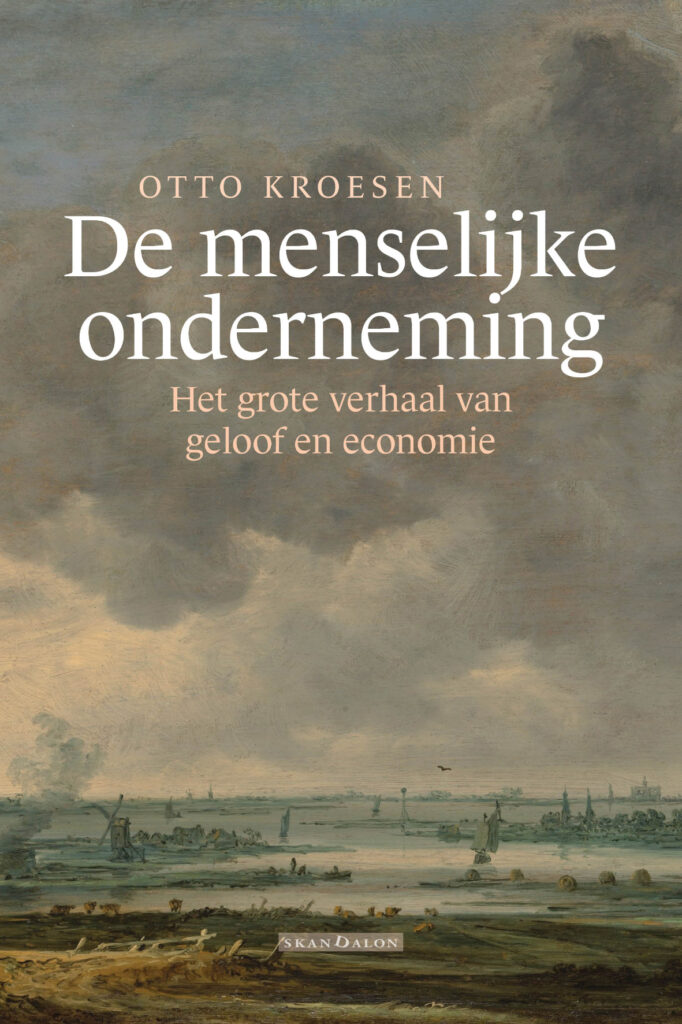
De menselijke onderneming: het grote verhaal van geloof en economie

For English and for German scroll down.

De strekking van dit onlangs verschenen boek wordt hier in een aantal bondige stellingen aangeduid.

1. Elke samenleving heeft een eigensoortig geloof in de vorm van vaststaande waarden en zienswijzen. Dat geldt heel de geschiedenis door. De waarden van nu zijn de goden van vroeger. De goden van vroeger zijn de waarden van nu.

2. Op historische hoogtepunten hebben nieuwe waarden, zienswijzen, woorden aan de samenleving een andere marsroute gegeven. Een andere ordening komt tot bloei. De stammen hebben geluisterd naar het gezag van de voorouders. Rijken zoals Egypte hebben gehoorzaamd aan keizers en sterren. Israël heeft profetisch een gerechtigheid geclaimd die nog komende is.

3. De taal is gevormd door de geestelijke machten en ervaringen die ons “zelf” gevormd hebben. Taal geeft binding aan het verleden, aan elkaar en openheid naar de toekomst. De taal die we spreken is zelf een verzameling richtinggevende woorden en gezaghebbende machten.

4. De christelijke stem kan alleen gehoord worden binnen een groter geheel van stemmen uit verschillende culturele of religieuze tradities. Juist de christelijke stem geeft het ritme aan: wanneer is ophouden nodig en opnieuw beginnen? Kruis en opstanding, vertaling van het ene tijdperk in het andere, vanuit het nieuwe het oude hernemen, is kenmerkend christelijk.

5. Steeds opnieuw zijn mensen door hiërarchische aansturing kort gehouden en/of hebben ze als radertjes in de machine zelf de gemakkelijkste weg gekozen (de vleespotten van Egypte). Steeds opnieuw dreigt de proletarisering. Men kan dan alleen nog maar praten over de dingen van de dag. Men gaat situaties mijden die om verantwoordelijk handelen vragen.

6. Groter worden, volwassenen spreken en leven voor de lange duur vraagt erom bewust de stemmen van het verleden tot zich te nemen en de waarden en namen en geestelijke machten van het verleden in de huidige tijd opnieuw te belichamen. Alleen wie echt geluisterd heeft, heeft ook zelf wat te zeggen.

7. De kerk en haar boodschap zijn naar de achtergrond gedrongen. Maatschappelijke krachten nemen de beslissingen. Deze plaats van de kerk op de achtergrond en de maatschappij op de voorgrond is kenmerkend voor het tijdperk van de Geest. Dat verandert de missie van de kerk. De kerk heeft niet de leiding maar geeft oriëntatie vanuit de achtergrond.

8. Als anonieme radertjes in de machine roepen mensen om identiteit en saamhorigheid. Kort gehouden mensen zoeken compensatie in almachtmythen en complotdenken. Mensen genezen door kleine ondernemingen, vooral in de economie, die van ieder verantwoordelijkheid vragen, en waarin verschillende bijdragen elkaar corrigeren en levend houden. De stam in de politiek leidt tot fascisme; de stam op economisch gebied leidt tot creatieve interactie.

De menselijke onderneming: het grote verhaal van geloof en economie

Otto Kroesen (voormalig studentenpastor en docent cross-cultureel entrepreneurship)
2022, Skandalon, 350 blz., € 32,50
Otto Kroesen

The human enterprise: the great story of faith and economics

The thrust of this recently published book is indicated here in a few concise statements.

1. Every society has a belief of its own in the form of fixed values and views. This is true throughout history. The values of today are the gods of the past. The gods of the past are the values of today.

2. At historical high points, new values, views, words have given society a different marching order. Another order comes to fruition. Tribes have listened to the authority of ancestors. Empires like Egypt have obeyed emperors and stars. Israel has prophetically claimed a righteousness yet to come.

3. Language has been shaped by the spiritual powers and experiences that have shaped our “selves.” Language gives bonding to the past, to each other and openness to the future. The language we speak is itself a collection of guiding words and authoritative powers.

4. The Christian voice can only be heard within a larger set of voices from different cultural or religious traditions. It is precisely the Christian voice that sets the rhythm: when is it necessary to stop and start again? Cross and resurrection, translation from one era into another, from the new into the old, is characteristically Christian.

5. Again and again, people have been cut short by hierarchical control and/or, like cogs in the machine themselves, have chosen the easiest path (the meat pots of Egypt). Again and again proletarianization threatens. One can then only talk about the things of the day. One starts avoiding situations that call for responsible action.

6. Growing up, speaking as adults and living for the long haul requires consciously taking to oneself the voices of the past and re-embodying the values and names and spiritual powers of the past in the present. Only those who have truly listened have something to say themselves.

7. The church and its message have been pushed into the background. Social forces make the decisions. This place of the church in the background and society in the foreground is characteristic of the age of the Spirit. This changes the mission of the church. The church is not in charge but gives orientation from the background.

8. Like anonymous cogs in the machine, people cry out for identity and belonging. Short-tempered people seek compensation in omnipotence myths and conspiracy thinking. People heal through small enterprises, especially in economics, which demand responsibility from each participant, and in which different contributions correct and keep each other alive. The tribe in politics leads to fascism; the tribe in economics leads to creative interaction.

Das menschliche Unternehmen: die große Geschichte von Glaube und Wirtschaft

Die Stoßrichtung dieses kürzlich erschienenen Buches wird hier in einigen knappen Thesen wiedergegeben.

1. Jede Gesellschaft hat ihren eigenen Glauben in Form von festen Werten und Ansichten. Das gilt für die gesamte Geschichte. Die Werte von heute sind die Götter der Vergangenheit. Die Götter der Vergangenheit sind die Werte von heute.

2. Auf historischen Höhepunkten haben neue Werte, Ansichten und Worte der Gesellschaft einen anderen Marschbefehl gegeben. Ein weiterer Auftrag kommt zum Tragen. Die Stämme haben auf die Autorität der Vorfahren gehört. Reiche wie Ägypten haben Kaisern und Sternen gehorcht. Israel hat prophetisch eine noch zu erwartende Gerechtigkeit eingefordert.

3. Die Sprache ist von den geistigen Kräften und Erfahrungen geprägt, die unser “Selbst” geformt haben. Die Sprache schafft Verbundenheit mit der Vergangenheit, mit den Anderen und Offenheit für die Zukunft. Die Sprache, die wir sprechen, ist selbst eine Sammlung von Leitwörtern und autoritativen Mächten.

4. Die christliche Stimme kann nur innerhalb eines größeren Kreises von Stimmen aus verschiedenen kulturellen oder religiösen Traditionen gehört werden. Es ist gerade die christliche Stimme, die den Rhythmus vorgibt: Wann ist es notwendig, aufzuhören und neu anzufangen? Kreuz und Auferstehung, die Übersetzung von einer Epoche in eine andere, die Rückgewinnung des Alten aus dem Neuen, das ist typisch christlich.

5. Immer wieder sind Menschen durch hierarchische Kontrolle zu kurz gekommen und/oder haben, wie Rädchen in der Maschine selbst, den einfachsten Weg gewählt (die Fleischtöpfe Ägyptens). Immer wieder droht die Proletarisierung. Man kann dann nur noch über die Dinge des Tages reden. Man fängt an, Situationen zu vermeiden, die ein verantwortungsvolles Handeln erfordern.

6. Um erwachsen zu werden, erwachsen zu sprechen und langfristig zu leben, muss man die Stimmen der Vergangenheit bewusst zu sich nehmen und die Werte, Namen und spirituellen Kräfte der Vergangenheit in der Gegenwart neu verkörpern. Nur diejenigen, die wirklich zugehört haben, haben auch etwas zu sagen.

7. Die Kirche und ihre Botschaft sind in den Hintergrund getreten. Die gesellschaftlichen Kräfte treffen die Entscheidungen. Diese Stellung der Kirche im Hintergrund und der Gesellschaft im Vordergrund ist charakteristisch für das Zeitalter des Geistes. Dies verändert den Auftrag der Kirche. Die Kirche ist nicht führend, sondern gibt aus dem Hintergrund Orientierung.

8. Wie anonyme Rädchen in der Maschine schreien die Menschen nach Identität und Zugehörigkeit. Kurzatmige Menschen suchen Ausgleich in Allmachtsmythen und Verschwörungsdenken. Die Menschen heilen durch kleine Unternehmungen, vor allem in der Wirtschaft, die von jedem Verantwortung verlangen und in denen unterschiedliche Beiträge sich gegenseitig korrigieren und am Leben erhalten. Der Stamm in der Politik führt zum Faschismus; der Stamm in der Wirtschaft führt zu kreativer Interaktion.


Posted by Otto Kroesen, 0 comments

The Calvinist work ethic

Calvinism has become proverbial, even for people without any idea of religion or faith. Calvinism and work ethic actually coincide for the common understanding. This makes the title of this blog sound like a pleonasm. After all, Calvinism is work ethic!

When people want to explain why such is the case, they always revert to Weber. Weber explains the Calvinist ethic from a pietistic attitude: how do I get to heaven? According to Calvinism, he explains, you could never know that for sure, because before the foundation of the world God decided who would be admitted and who would not. And that doesn’t depend on faith or achievement. But, Weber points out, the Calvinists had found a way to get around that. You can never know it for sure, but if you were able to achieve a good life through work and effort, then that was a good indication; a sign that you belonged to the elect.

Here Weber, as a German, shows himself to be more familiar with the Lutheran tradition that asks the question, “How do I get a merciful God?” This pietistic attitude also had its influence in Calvinist countries, but it is not really the origin of Calvinist work ethic. The Calvinists were not individualists. Nor were they pietistic individualists.

For Calvin and his followers, the congregation was central, the community from below. So in England and the Netherlands where Calvinism was strong you see a recurring emphasis on cooperation and trust. That led to the first joint stock corporations, where people put their investments under joint management. That demanded a high degree of trust. And that trust came about not through anxiety about individual salvation, but through the covenant with God and the human community that was called into being by this divine covenant. That was going to realize God’s Kingdom in this world.

Both in England and in the Netherlands one sees coming about the construction of canals, the draining of marshes and the development of the land in a common effort. In a certain sense the Calvinist congregations continued the work of the guilds. The guilds too were not only labor organizations but also religious organizations, and why? They, too, had to constantly cultivate their religious beliefs together in order to keep each other in line and guard the common morality. They had to prevent individuals from being more focused on their own advantage, or that of their own family, and thus harming the common cause, even if only by stealing the treasury and that sort of thing.

Cooperation was thus surrounded by religious sanction and motivation. Therefore, in Calvin’s Geneva, where this new commitment was first put into practice, entrepreneurs had to be on their guard. Those who made exorbitant profits could expect the church council paying a visit to them! Profit was allowed and even required, but it was to serve a common goal: social welfare and justice.

Certainly, as success increased a kind of secularization occurred. Instead of the congregation and the covenant, the idea of the social contract emerged. In this conception, God is not needed and people make a covenant with each other for mutual benefit. It is rationalistically motivated: well reasoned self-interest and commerce. But that should not lead one to underestimate the original religious motivation! Weber likes to denigrate the religious anxiety that led to such great labor achievements. For him, it is a paradoxical ironic fact: heavenly salvation leads to earthly success.

The pursuit of heavenly salvation leads to earthly success: in fact, it always works like this. A new economy can only come about by high inspiration. In this sense, economics is always salvation economics. In our time this is just as true. Innovation never comes from the selfish, but always from people who act with self-forgetfulness. Why is this so? Innovation always requires excessive commitment. And it is not a question of religious people being better able to exercise such commitment (after all, this is not true for the average churchgoer), but of recognizing that this this excessive effort itself inescapably has a religious character! Religious here means: high words are invoked and evoked for which people are willing to pay a price, and they are leading.

This is also visible in the field of entrepreneurship. The pioneers often fail. But they pave the way for the success of others, and from then on it just seems to be all just human effort.

Posted by Otto Kroesen, 0 comments

Generations and climate change

Dwarf and giant

We receive the world we live in from the previous generation. We do something with it in our own time. We pass on this new world to the next generation. – That insight has been lost. We live in our own time. In our own world or our own bubble, as it is called nowadays. Therefore, it is no surprise that climate change is knocking at our door and calling for a change in our way of making a living.


A continuous present

We live in a continuous present. We are no longer connected to multiple times. The farmer and the shoemaker used to have to work on the transfer of their profession themselves. They employed and taught people who took over the trade. They spent perhaps a third of their time doing so. That gives a completely different sense of reality. You know much better that there will be a time after you. We have lost sight of that.

An organization benefits most if you do one thing without ambiguity, efficiently and repeatedly.

The fact that we have lost that insight is not only due to one-sided education. This one-sided education itself is caused by a one-sided way of life. The core of this is a one-sided way of working and earning a living. Most people work in large organizations and are deployed on some sub-process. They continuously do so, if possible throughout their career. It is no longer part of the work that you also think about and work on changing the content of the work itself. An organization benefits most if you do one thing without ambiguity, efficiently and repeatedly. At least that works in the short term. In the short term, this provides the most efficiency, and therefore generates the most revenue. In the long run it is always a problem, of course, because if you have only learned one trick, then what about your ability to learn new tricks?

Dwarves and giants

As a result, modern organizations are producing spiritual dwarfs. They are very good at one thing, but they can no longer think outside or beyond it. Of course, changing and learning always hurts, but if one dares to do so, it brings gross. In the organization in which I work, the TU Delft, satisfaction surveys are occasionally conducted, as is the case with many others. That fits well with this existence of dwarfs: you have to keep them short, but also satisfied. Such little people live in their work like cogs in the machine and in their spare time they are allowed to create their own bubble.

They are very good at one thing, but they can no longer think outside or beyond it.

The managers in such organizations try to achieve the greatest possible efficiency and pull the strings of the people to this end. If you want to be successful, you have to go with the trend and get as much out of it as possible so that the organization grows, and with that the prestige of your position grows, possibly also your income and influence. An organization that thinks in the short term thus creates spiritual dwarfs on the one hand and clumsy giants on the other. Giants are always clumsy because they don’t see where to put their feet. They don’t know what they exist for. They know of success, but not of succession.

Living in generations and sustainability

If an organization has to change, if a new world of institutions and practices has to be created for the time after us, this continuous present no longer works. In a world of dwarfs and giants, the human dimension is lost. It is typical that such a term now suddenly becomes part of the social debate: the human dimension.

What should the world of the next generation look like? What should we do so create? Nobody knows in detail. Managers should therefore become leaders. That is to say, they must take the lead in a process of change. That makes them smaller than they were. Because one cannot lead if one cannot listen. After all, you don’t know how to do it yourself. We all make an attempt. But that also means that all employees become more than just employed. The change must take place at all levels and it is a challenge for everyone to find a way which does not yet exist. That requires a lot of mutual discussion and communication. That makes the employees bigger.

After all, you don’t know how to do it yourself. We all make an attempt.

Such talk and speech between management and employees is an absolute necessity. That also takes time. And so in the short term the least efficient is what yields the most in the long term. Not only does it deliver better results in the long run. But only those people really grow who also make sacrifices and make an effort to transcend themselves. That demands that we live in a larger time perspective. This requires that we can draw on a broader repertoire of values and words by which we interact with each other. That requires us to ask more explicitly the question: what should we inherit and where should we go? Responsible people desire less to get confirmation within their own bubble. Instead they want to test their self-evident views in order to make progress.

In short, no sustainable world if people are not prepared for the long term.

Posted by Otto Kroesen, 0 comments

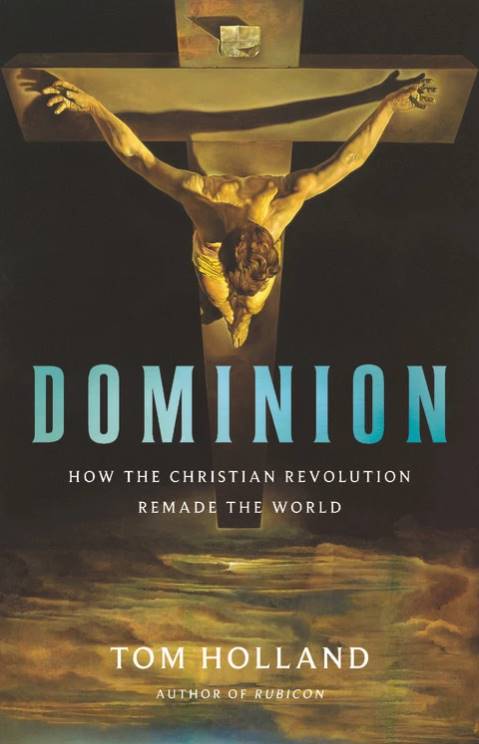
Tom Holland – Dominion

Amid the other books of Tom Holland, the book Dominion is a remarkable book. In other books he is often the skeptical contemplative academic, even if he is nevertheless a strong storyteller. However, this book is not only interesting, but it also has a message. He tells how the message of the Christian faith has changed the world.

A different Tom Holland

But in order to be able to tell that story, he first had to go through a change himself. He tells about it in the introduction and in the epilogue. Although he had already departed from the faith of his childhood, when he visited the Middle East, at the front, during the time of Islamic State, and saw and heard of the crucifixions they had carried out and the selling of women and children like slaves he got a different view of history. The Christian faith has changed society, public morals, manners. Not that no major crimes have been committed within the Christian world and by Christian civilization itself. But both with naming the achievements and criticizing the crimes – we actually are participating precisely in the tradition of Christianity itself, according to Tom Holland.

It is therefore not surprising that Tom Holland starts his book with the meaning of the cross as punishment and as a fearsome threat to slaves. That was already the case with the Persians. In a society of 90% slaves, such as the Roman Empire, it is the way to frighten and keep the slaves calm. In that world the church, Paul especially, comes with the message of faith in the crucified Christ as a new way of life. This belief involved an intensive form of charity that was unusual in society at the time. Taking care of foundlings, burying the dead, who often were left unburied and disposed as garbage if they were poor, sharing of food. The Roman Empire increasingly found these forms of charity in opposition to it, firmly organized. Many martyrs, especially those of the highest rank, who had become Christians, but also ordinary soldiers, were willing to suffer death and persecution.

Wherever this belief went it instituted a new morality, and it also influenced the Western European tribes, while at the same time this belief was attractive to the leaders of these tribes, as a moral power that legitimized their authority not only over their own tribe, but also over other tribes. Once their rule had been supported by the authority of Christ and the Church, it gained in credibility, but in turn this was also due to the fact that, according to that same belief, they could no longer serve merely their self-interests.

A broader perspective

The book provides many stories that actually require to be understood within the broader perspective of Western history. For those who do not see that thread, the storyline of the book becomes somewhat anecdotal, because Tom Holland does not always, usually not, provide that broader perspective. Why are there martyrs, and saints, who even spend that time sitting on a pillar in the desert sometimes? At another time there are revolutionaries, such as the Albigensians and the Hussites, who take up arms not only against the worldly powers but also against the church. Why? Certainly, he wants to point out the ambivalence of Western and Christian history and he does so throughout the book. The Christian faith has been used to justify power and control, as much as to justify opposition to it. But he leaves the question open, why at different times people also face different challenges. Hermits and saints who lived in the desert were needed to convince the people that the power of the demons had been broken. But once that is successful, new tasks emerge. The world now abandoned by the demons must be ordered and organized. That is almost an unavoidable next step. These kinds of insights are missing in the book.

Secularization is internalization

Nevertheless, there are two important points he makes. The first is particularly evident at the beginning of the book, and I just described it: Christianity and its morals have made sure that we finally (hopefully) departed from the violence and horrors of ancient times (and their religious legitimation!). That is one.

The other is his view of the post-Christian secularized world and morality that is now prevalent. It has been introduced since the French Revolution, step by step. We leave the Christian faith and its morals behind us, we are beyond them – at least our culture is to a large degree committed to that conviction. But is that really the case? If enlightenment puts rationality in the place of faith and proclaims human rights, is that a departure from Christianity, or a continuation of it? If Lenin and the communists impose a strict regime of scientific socialism and planning economy on society, does his revolution not breathe the same spirit as the revolution of the pope against the emperor in the Middle Ages? In both cases a cynical power game takes place in which all means are permitted to achieve the (good) goal, that from now on things since we really take a different shape. Christian spirit? Such questions are asked by Tom Holland and he does not get tired from pointing out how, in secularized form and despite the explicit rejection, the achievements of the Christian era are also continued by the greatest atheists. He mentions the #MeToo movement as a final example at the end of his book. Apparently we have a culture in which the brakes on public morality have been released, such as monogamous marriage and lifelong loyalty, but under the label of self-determination and women’s rights, the puritan morality of inner self-restraint and respect for the other still returns.

Should the Christian faith step out of its shadow?

A beautiful and important insight from Tom Holland lies in a single comment he makes almost in passing. Earlier in the book, he pointed out that in the abolition of slavery, western politicians and religious leaders deliberately pointed to innate human rights as a motivation, and not to the Christian belief that was really behind it. In this way, according to Tom Holland, with respect for the Islamic religion (the Quran unambiguously allows slavery and Mohammed himself had slaves), or Hinduism, one could prevent others from feeling they had to bow to Christian values. The end of slavery was not motivated by Christian values, but on the grounds of a generally valid human nature. It was better to keep the Christian motivation anonymous. Now the situation may look a bit different. Almost casually, Tom Holland notes that a rethinking of Western European history stamped by Christianity is now necessary as we are about to see other superpowers take over the leading role in world history. Again, Tom Holland only mentions that in passing, but it may nevertheless be an important message from his book. Indeed, in order to keep the modern world of states from falling back into pre-Christian times, it is more necessary to recall the way in which we got where we are now. The neoliberal adage of everyone for himself and the market for us all is slowly coming to an end. Too many people are offside. Neo-liberalism ignores the deeper values ​​that are the secret of Western democracies. Those values ​​are not so obvious. They have been introduced into society through the Christian faith, through Jesus, Paul, Peter and the other apostles. The Christian attitude towards to life is the supporting force and the lasting inspiration behind it. And it will remain so, as long as people feel the need to see the world through the eyes of the victims, and powers that be through the eyes of the underlying, and as long as ordinary people create forms of cooperation independent of family and state, in order to give to society a more human face. This history still sets the normative standards for the future.

Tom Holland, Dominion, The making of the Western Mind, Little, Brown, 2019.

Posted by Otto Kroesen, 0 comments

Observations (Blog)

Plastic language

Our language has become a plastic product. I do not want to say anything to the detriment of plastic, but plastic is for daily use. What is used on a daily base must be manageable. The language we use is an instrument in our hands and we shape it ourselves at will. It is our construction. We are the ones who “frame” language.

It is the language of the store and of the company. In the store and in the company you have to be able to point at things and what you can point at is what you mean. What does not fall under this category does not exist. What you cannot point down is not there. It is therefore customary in society to speak in the indicative form, the indicative. I need that hammer. I want to buy that coat. It is also possible to say: I like that! But that is about it.

Yet that is not enough even in the store and in the company. There too people have to rise above the flat surface. You can also be touched or be addressed by something. Then something poetic creeps into the language used. Not only are you the one doing things, but things “do something with you” as well. Do these kinds of “things” that do something with us, really exist? We do not only live, but we are also lived, by powers that appeal to us, by faces and values ​​that we cherish. Names and words that are of a bigger format than we.

The words also grow bigger at the occasion of great events. You will find that in titles of address, in solemn terms and big names. “Do you take as your wife…” and so forth: A just society! A sacred call! Promises! “In the name of …”; … yes of what, of the law, of a higher power, the name above all name …Love, suffering, mercy… With the use of bigger words somehow we enter the realm of religion and religious discourse. Because now words are no longer our instruments, but the one who pronounces these words becomes the instrument of the words pronounced. You are no longer at the center. You are no longer the one who moves, but you are moved.

But for daily use we also need relaxation. Everyday language needs flattened words. To love your work – that expression is just fine, but you are not married to your work. In a company, we speak of involvement or connection instead. In fact, we also mean that we care about our employees or colleagues , but Love is too big a word in that context. The theme of this website is the tension between the daily language (where there is little tension) and the big words that occupy our whole lives. The intention is for big words to descend and daily words to become somewhat more elevated and for them to meet halfway. The adage of the Benedictines was “ora et labora”, pray and work. The little things that return every day must be dealt with in the light of the big names and words (or values) we ultimately live for. Only then will religious words not become empty and the daily language not become flat.

Posted by Otto Kroesen, 0 comments